
Indian Paediatrics & Critical Care
Loading QBank Portal & Clinical Guidelines...
Loading QBank Portal & Clinical Guidelines...
STATION 10
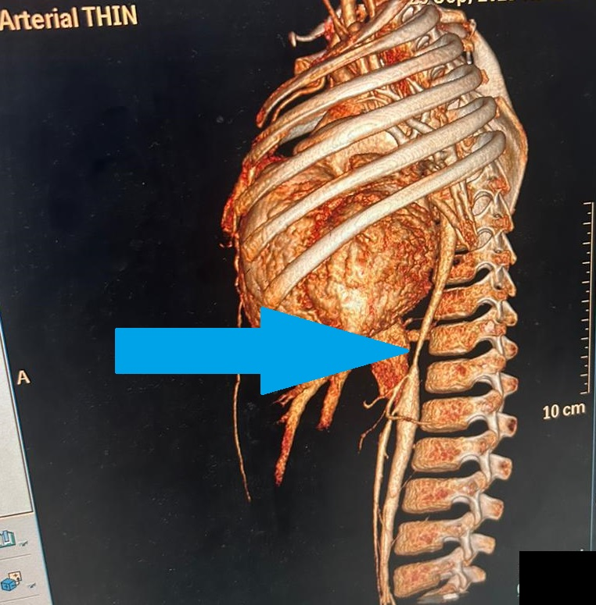
A previously healthy 6 year old female came with C/O fever for 2wk, and difficulty in breathing for last 3 days, on admission pt had tachycardia, tachypnoea with feeble femoral pulses and 2-D Echo show Dilated left ventricle with Ejection fraction <15%, BP in Upper limb was 134/96 while in Lower limb 72/54. A diagnostic imaging modality was done shown below in figure. Look at the figure and answer the following?
Marks
Q 1) What is this diagnostic imaging modality ? 1
Q 2) What is the arrow showing in above depicted picture? 1
Q 3) Identify the diagnosis ? 1
Q 4) Write any two differential diagnosis of above condition ? 0.5*2=1
Q 5) Write any one management option. 1
At a basic level this is a condition which results from the cerebral oedema that occurs when an ineffective osmole is enthusiastically extracted from the extracellular fluid by dialysis. In this, it resembles the cerebral oedema that can develop with the rapid overcorrection of glucose in a patient with a hyperosmolar hyperglycaemic state. Its one of those rare disease states that, when first recognised, was immediately and fully understood by the authors of the seminal article, with little else added in the subsequent years.
That seminal paper was Kennedy et al (1962), and is really just a letter to the editor of the Lancet. This group of clinicians noted that among renal failure patients with uraemia, a group failed to improve following dialysis - instead developing worsening confusion even while their biochemistry looked better. They made the connection between this phenomenon and the urea concentration, taking a hint from contemporary neurosurgical practices (where at the time it was routine to give doses of urea for cerebral oedema, in the same way as in the modern era one might give mannitol). Coming to the conclusion that some sort of a reverse version of this effect must have been operating in their patients, they followed this up with a series of experiments, demonstrating the lag between blood urea and CSF urea concentrations. In this manner, Kennedy et al were able to demonstrate that a concentration gradient is established during and after dialysis.

Cold Shock: Dopamine / Adrenaline first-line. Warm Shock: Noradrenaline first-line.
PALICC-2 Criteria: Oxygenation Index (OI) = (MAP x FiO2 x 100) / PaO2.